Is it okay to use AI for college essays? It depends entirely on what the tool does. A tool that asks a student questions and helps them find their own material is fine — it's the same work a good writing teacher does. A tool that generates finished prose for them is not, and no amount of editing afterward fixes that. The useful test isn't whether AI touched the essay. It's whether anything would be left if you took the AI away.
That distinction is simple to state and surprisingly hard to apply, which is why this has become one of the most fiercely debated topics in admissions right now — and why the arguing tends to produce more heat than actionable guidance. So people go looking. A parent, usually. Sometimes a student. They type some version of "college admissions AI" into Google and try to figure out something that isn't easy to figure out: which of these tools will actually help.
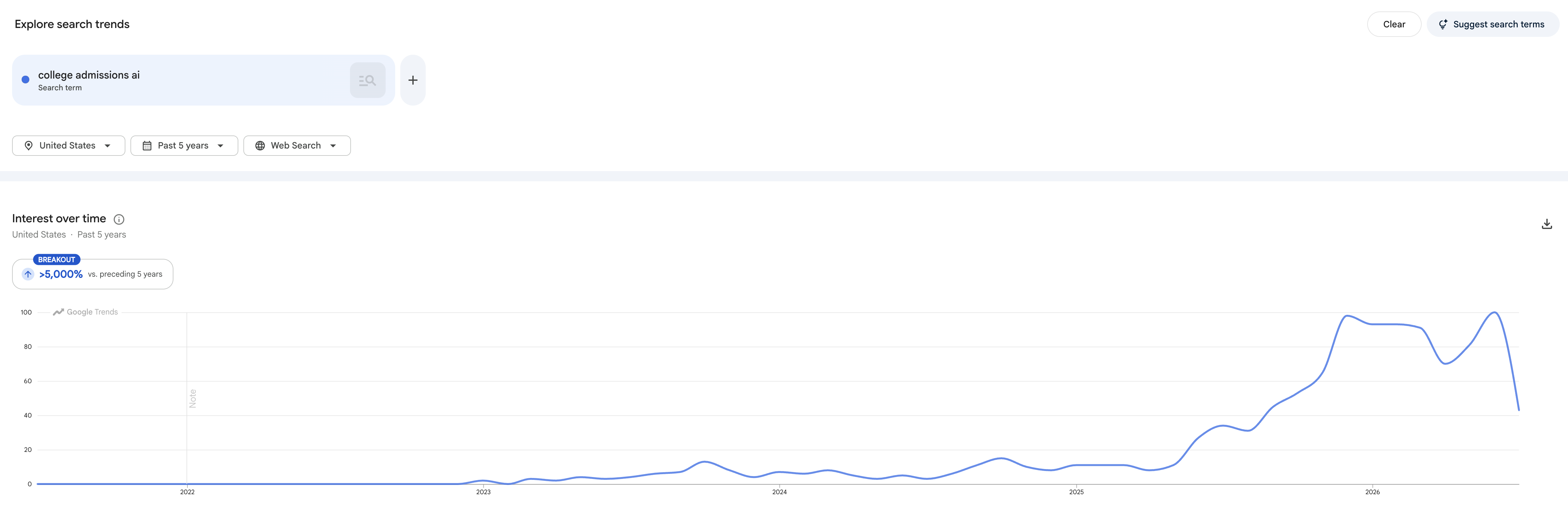
It's not hard to see why this is happening. Every few weeks, a new app or tool promises to write your essay in a way that'll make admissions officers at the most selective institutions swoon, score your application along the 37 never-before-revealed criteria schools purportedly use to make their decisions, or unleash military-grade cyber tools to evade any plagiarism and AI checkers schools may be using.
Some of these apps and tools are genuinely useful. Some of them are actively going to hurt the kid who uses them. But from the outside, they look almost identical.
Here's a way to tell them apart that has nothing to do with reviews, price, or how polished the website looks.
How can you tell if an AI essay tool is actually helping?
Some tools, if you removed them, would leave nothing behind: no essay, no ideas, no progress. The AI was doing the work.
Other tools, if you removed them, would leave a kid who's thought harder about themselves than they had before, holding notes and half-formed ideas they generated, with or without the app. The AI was doing the asking, not the answering.
AI should help an applicant become a stronger and more articulate advocate for who they really are.
Should my kid use an AI tool that writes the essay for them?
Type in a few prompts — your extracurriculars, maybe a sentence about your background — and voila! out comes a full essay or 3–5 topic options ready to write from. This is the category to be most careful with, for a reason that has nothing to do with rules or getting caught. A personal statement only works if it's actually personal — if the specific texture of how one particular kid thinks comes through on the page. An AI generating that texture from a prompt is, by definition, producing something generic dressed up as specificity. Even when it reads smoothly, admissions readers who go through thousands of these essays a year develop an ear for the ones that don't sound like anyone in particular. And more importantly than getting caught: a kid who submits a generated essay hasn't done the one piece of the process that was ever going to be useful to them beyond this application — the work of figuring out what they actually think.
Can colleges detect AI in college essays?
This is the question most families ask, and it isn't quite the one the schools are asking. Read how selective colleges actually write their AI policies and you'll notice how little they say about detection software. They talk about fraud instead. Yale's admissions office states that submitting "the substantive content or output of an artificial intelligence platform" constitutes application fraud, and can result in revoked admission or expulsion — with no reference at all to whether anyone catches it. The same policy explicitly permits the other side of the line: grammar and spelling checks, and asking AI for general advice or topic suggestions at the start of the writing process, are fine.
That distinction is the whole ballgame, and it's drawn in almost exactly the place this piece has been arguing for. So the practical risk isn't a detector flagging an essay. It's submitting something that isn't yours, in a process whose entire premise is that it is.
Some tools now market a feature that should be a blindingly bright, flashing warning sign rather than a selling point: writing designed to evade AI-detection software. But a tool that has to defeat detection isn't refining a student's authentic voice — it's manufacturing a substitute for one and hiding the seam. If a product's pitch includes getting past the systems built to catch exactly what it does, that's your unambiguous cue to turn and run.
Are AI essay scoring and feedback tools worth using?
This category is more of a mixed bag, and worth a slightly closer look. Feedback on structure, clarity, pacing — did you bury your best sentence in paragraph three? does your opening earn attention? is there a scene here or just a summary of one? — can be genuinely useful, the same way a good writing tutor's margin notes are useful. The risk here isn't the feedback itself, it's what the feedback optimizes for. A scoring tool trained to predict "what gets you in?" is essentially teaching a kid to write-by-numbers, which is pretty much the opposite of what a personal statement is supposed to do. Worse, any experienced admissions officer will confirm there is no formula for a winning essay: every year, kids are admitted to the most competitive schools with essays about muffins or millipedes. So it's critical to ask: Is this telling me whether my writing is clear and reveals something interesting about me as a person, or is it telling me whether my writing resembles other writing that got results? Those sound similar. They aren't.
What does a genuinely good AI college essay tool actually do?
This is the category worth paying attention to, and it's the least flashy of the three — which is probably in part why there's less hype around it. Instead of generating an essay or a score, the tool uses AI to ask questions — about a memory, a habit, a moment that stuck with you for no clear reason — and then asks a follow-up, and another, potentially over days or weeks rather than one sitting. Nothing gets written for the student. What gets produced instead is raw material: messy notes, half-formed observations, a paragraph about a random Tuesday that seemed pointless to write down.
These tools then help the student identify pre-existing but undiscovered patterns in the output. These patterns don't necessarily show up in one session. They show up on the second or third read-through of that raw material, when something they wrote about a debate tournament rhymes, unexpectedly, with something they wrote about their little brother.
That deliberateness is the point, not a flaw to route around. As any accomplished writer will confirm, reflection isn't something you can summon by asking yourself "what am I passionate about?" and waiting for an answer to arrive. It's something you find by writing down a lot of ordinary, unimpressive material and reading it back later, looking for what repeats. A tool built around that process may feel less immediately satisfying than one that hands you a finished essay in ninety seconds — but it's the one actually worth the time, because it helps schools understand what makes your kid stand out from the tens of thousands of other applications they read. That's not a soft claim, either: every one of the 33 selective colleges whose Common Data Set we examined rates the application essay as important or very important, and 20 of them rate it above standardized test scores.
This is the category Youward's free Essay Topic Generator falls into, for what it's worth — you paste in a real prompt, answer a few short questions about something specific you care about, and it hands back possible directions grounded in what you actually said. Nothing gets written for you. It's free, and it doesn't ask for an email.
A few concrete questions to ask about any tool before trusting it with your kid's essay
Does it produce something you could submit today, or does it produce material you'd still need to write from? The first is a red flag regardless of how good the writing sounds.
Does its marketing mention detection, plagiarism-checkers, or "sounding human" as a feature? That's a tell about what the tool is actually built to do.
Does it ask more questions than it gives answers? A tool doing real work usually looks, from the outside, like it's doing less.
Is the process measured in days or weeks, or in one brief sitting? Genuine reflection has a shape that a single prompt-response exchange can't replicate — it's iterative, and it benefits from time away from the page.
Who would be able to tell you, honestly, what this essay is about — the student, or the tool? If the student can't yet explain in their own words why the topic matters to them, the essay isn't done, no matter how finished it reads.
None of this requires distrust of AI as a category, and none of it is really about AI at all. It's the same test that's applied to human help for as long as college essays have existed — an overbearing consultant — or an overbearing parent — who rewrites a student's sentences causes the same problem an AI generator does, just more slowly and expensively. (I wrote separately about where that line sits for parents.) Caltech's admissions office proposes almost exactly this test in its own published AI guidelines: before using an AI tool, ask whether you'd be comfortable having a trusted adult do the same thing. A teacher checking your spelling? Fine. A teacher drafting the essay for you to lightly revise before submitting? Obviously not. The question shouldn't be "Did a machine touch this?" It's "Does the finished piece belong to the kid whose name is on it?" That's still the only question that matters. It's just gotten a little harder to answer at a glance.